AI isn’t killing SaaS it’s rewiring it, shifting cloud systems from reactive automation to predictive autonomy. PaaS now ships “AI building blocks” like managed LLMs, vector databases, and MLOps pipelines, and SaaS is turning UI-driven tools into autonomous, goal-oriented agents (“Service as Software”).
Legacy modernization can be incremental: abstract data into a vector store for RAG, expose business logic as APIs and tools for AI agents, add an AI proxy layer to keep models swappable, and evolve CI/CD into continuous evaluation with LLM-as-a-judge. The payoff shows up across code review, scaling, deployments, and monitoring with AIOps and dynamic cost optimization as natural entry points.
Bottom line: no need to rebuild from scratch. Embed AI iteratively into existing pipelines to cut friction, provision resources proactively, optimize costs in real time, and build systems that are genuinely intelligent, scalable, and resilient.
- The Evolution of Cloud Architecture and the AI Paradigm Shift
Over the decade, the standard approach to software development has followed a specific playbook: building multi-tenant cloud applications, securing them behind subscription models, and scaling operations. The primary goal has consistently been to keep systems resilient, scalable, and relevant, which was typically accomplished by shifting from monolithic architectures to microservices and trading manual deployments for automated CI/CD pipelines.
Today, a provocative question arises across the industry: Is the traditional Software as a Service (SaaS) model obsolete? While the short answer is NO, the core model is undergoing a fundamental rewiring. The technological landscape is transitioning from software designed merely to facilitate human tasks to intelligent systems that autonomously execute them, marking a definitive shift from reactive automation to predictive autonomy. Integrating Artificial Intelligence extends well beyond simply bolting a Large Language Model (LLM) onto a user interface; it signifies a profound transformation in the way backend infrastructure is constructed, deployed, and maintained.
- The AI Inflection Point Across the Cloud Stack (Product Architecture)
AI is becoming the foundational layer of modern software, driving a complete reimagining of the cloud services hierarchy.
- IaaS (Infrastructure as a Service) – The New Compute Economy: Traditionally defined by spinning up generic CPU instances and block storage, the infrastructure layer is now dictated by AI workloads. We are moving to accelerated compute driven by the demand for GPUs, TPUs, and AI-optimized networking like InfiniBand. Cloud providers are decentralizing inferencing to the edge to reduce latency, while centralizing massive clusters for model training. Technical leads must now factor GPU availability and inference cost into baseline budgets.
- PaaS (Platform as a Service) – The Abstraction of Intelligence: PaaS is no longer just about managed databases and container orchestration; it is about providing “AI PaaS” building blocks. This includes managed Large Language Models (LLMs) via API endpoints, managed Vector Databases (like Pinecone or hosted pgvector), and MLOps pipelines. Developers are using these offerings to chain prompts, orchestrate agents with frameworks like LangChain or LlamaIndex, and manage Retrieval-Augmented Generation (RAG) pipelines securely within private cloud perimeters.
- SaaS (Software as a Service) – From Tools to Agents: The standard SaaS model, which forces users to learn a UI, is fracturing. We are transitioning to “Service as Software,” where companies sell AI agents that autonomously draft emails, log interactions, and update CRMs in the background. The UI is becoming invisible or conversational, replacing deterministic workflows (If X, then Y) with probabilistic, goal-oriented workflows (Accomplish Z, figure out the steps).
- The Battle Plan – (Migrating Legacy Workflows)
Now a Days, User cannot write a ten-year-old enterprise application overnight; modernization must be incremental. Here is the architectural battle plan to migrate legacy, deterministic codebases into a non-deterministic future:
- Abstract the Data: Because AI is only as good as its context, and legacy apps trap data in rigid relational schemas, you must build a continuous data pipeline. This pipeline asynchronously mirrors transactional databases into a Vector Store, creating a semantic layer ready to be queried by an LLM via a RAG architecture.
- API-ify the Core Business Logic: To allow AI agents to perform tasks, ensure your core CRUD operations are exposed via robust, secure REST or GraphQL APIs. Expose these internal APIs to the LLM orchestrator as “Tools,” allowing the AI to securely act (Tool Calling) on the user’s behalf.
- Introduce the “AI Proxy” Layer: Do not hardcode specific LLM integrations deep within your legacy monolith. Build an AI Gateway or Proxy service using modern PaaS tools to manage prompt formatting, rate limiting, and interaction with external providers (OpenAI, Anthropic, Gemini). This allows you to swap out models instantly without touching the legacy codebase.
- Evolve CI/CD into Continuous Evaluation: Testing AI-augmented software is harder than asserting 2 + 2 = 4. Modernize pipelines to include “Continuous Evaluation” by using LLM-as-a-judge frameworks. This automatically evaluates if the AI agent’s responses are accurate, helpful, and free of hallucinations before deploying to production.
- Bringing AI to the Backend and DevOps (The Paradigm Shift: Legacy vs. Modernization (AI-Driven)
The defining difference between traditional operations and AI-modernized environments is predictive autonomy. Organizations can integrate AI iteratively into existing pipelines to reduce friction and cognitive load.
Here is how the landscape is changing for backend teams:
| Domain | Legacy Cloud Process (Reactive) | AI-Driven Modernized Process (Predictive) |
| Code Review | Manual peer reviews; static analysis flagging known syntax/rule breaks. | AI-assisted PR analysis identifying logic flaws and context-specific bugs before merge. |
| Scaling | Rule-based autoscaling (e.g., “scale up if CPU > 80%”). Often leads to lag or over-provisioning. | Predictive scaling analysing historical traffic patterns to provision resources before a spike. |
| Deployments | Scheduled CI/CD pipelines with manual approvals and static canary steps. | Intelligent rollouts where AI monitors business metrics and error rates to auto-promote or rollback. |
| Monitoring | Alert fatigue from static thresholds; humans manually correlate logs during an outage. | AIOps clusters anomalies, suppresses noise, and surfaces the root cause instantly. |
- Where to Start Integration:
- AI-Driven CI/CD and Testing: In an AI-augmented pipeline, tools analyse the codebase to generate missing test coverage and dynamically adjust the test suite based on modified modules. Machine learning models evaluate commit risk based on historical failure rates, flagging high-risk deployments while fast-tracking low-risk updates.
- Intelligent Infrastructure Management (AIOps): AIOps tools ingest logs, metrics, and traces to learn the system’s “normal” baseline. If latency spikes, the AI does not just trigger an alert; it correlates the spike with issues like a database lock, links it to a recent deployment, and can execute an automated rollback script before a human intervenes.
- Dynamic Cost Optimization: AI models analyse usage patterns across the cloud provider to identify orphaned resources. They recommend instance type resizing based on actual workload profiles and automatically purchase or shed spot instances in real-time based on market pricing and traffic demands.
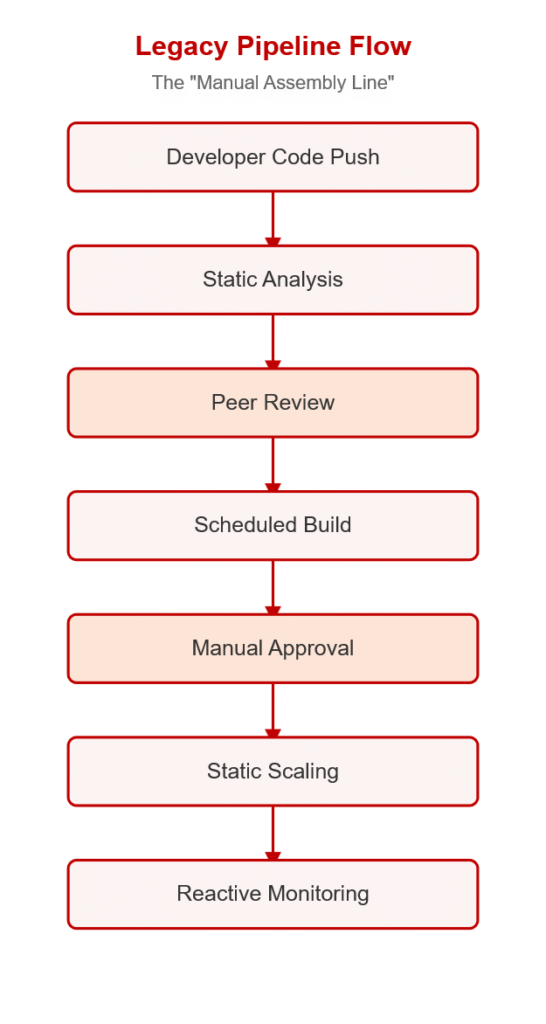
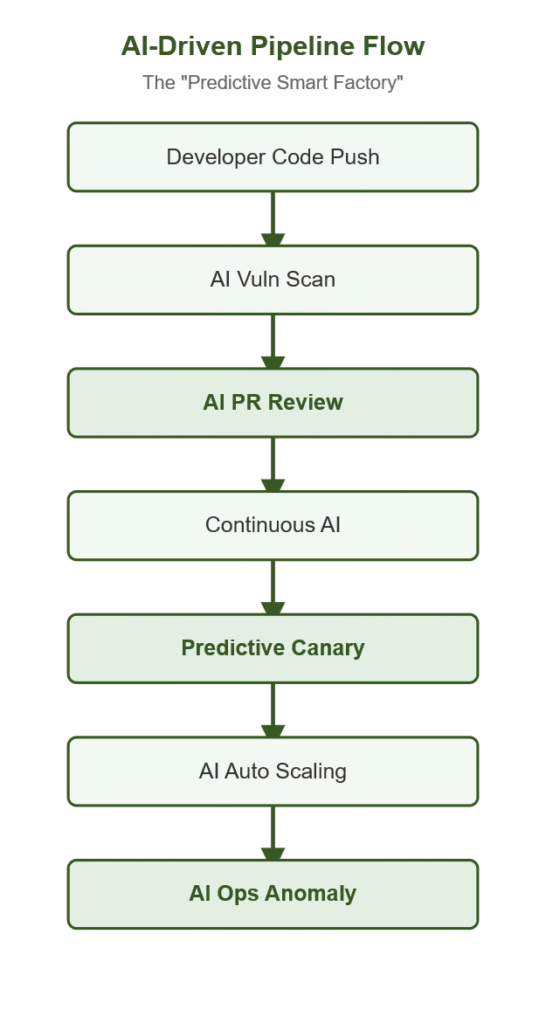
- CI/CD Pipeline Comparison:
Traditional CI/CD pipelines rely on strict rules and human approvals, creating frustrating delays. AI-driven pipelines act independently, spot risky code, adjust tests, monitor systems during rollouts, and instantly hit the undo button if things go wrong.
Below is the structural flow mapping the transformation from the Legacy Pipeline to the AI-Driven Pipeline:
- Legacy Pipeline Flow:
- AI-Driven Pipeline Flow
Conclusion and Key Takeaways:
The evolution of cloud development marks a critical transition from reactive automation to predictive autonomy. Organizations do not need to rebuild their entire architecture from scratch; instead, they can iteratively integrate AI into their current pipelines to reduce friction and cognitive load.
Key Takeaways:
- Intelligent Automation: AI-driven pipelines act independently by automatically identifying risky code, adjusting test suites based on modifications, and monitoring system health during rollouts to trigger automatic rollbacks if necessary.
- Proactive Management: Tools like AIOps and predictive scaling analyse historical data to provision resources ahead of traffic spikes and instantly surface the root causes of anomalies, moving away from static rules and manual log correlation.
- Optimized Operations: AI integration effectively removes development bottlenecks, prevents frustrating delays caused by human approvals, and dynamically manages cloud costs in real-time based on market pricing and actual workload profiles.
Ultimately, embedding AI into backend infrastructure represents a fundamental transformation in how software is built, shipped, and maintained, ensuring systems are not just automated, but genuinely intelligent, scalable, and resilient.
Leave a Reply